
PRODUCT OVERVIEW
In real life, physics don’t happen one at a time. Fluid, structural, thermal, and electromagnetic forces are constantly interacting. It’s where these domains collide that phenomena such as heat transfer, deformation, and mass transport occur. Multiphysics is the analysis of the complex interactions between physical forces through computer simulation. By bringing individual physics solvers together into a single computational framework, multiphysics workflows help engineers accurately
Product Features
Fluid-structure Interaction
Modeling how airflow (fluid dynamics) affects the deformation and shock absorption (structural mechanics) of landing gear.
Thermal-optics Coupling
Modeling how outdoor temperatures (thermal effects) affect the clarity of projected images in vehicles (optics).
Structural-acoustic Coupling
Modeling how aural feedback (acoustics) in vehicles is caused by tire-to-surface friction (structural mechanics).
Electromagnetic-thermal Coupling
Modeling how a motor’s energy fields (electromagnetics) produce heat (thermal dynamics) to optimize heat exchangers and fans.
MODULES
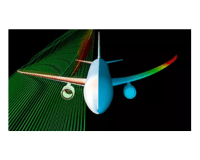
Aerospace
Fluid-structure interaction analysis to determine optimal weight, shape, and structure of aircraft wings.
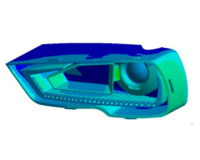
Automotive
Simulating thermal expansion and deformations in headlamps to predict optical performance.
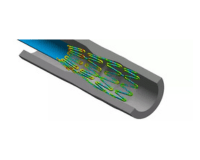
Healthcare
Modeling interactions between human tissue and medical device structures such as implants and stents.
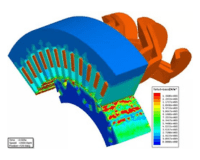
Industrial
Reducing wear and tear on motors by identifying vibration sources through magnetic, structural, and acoustic analysis.
Multiphysics Simulation
Realistic modeling
Accurately capture real-world scenarios where multiple physics domains interact simultaneously.
System-level analysis
Gain insights into how physics couplings influence overall system performance.
Time efficiency
Analyze entire systems at the same time, instead of in domain silos.
Data congruency
Different physical domains have different timescales, spatial scales, and mesh resolutions.
User expertise
Interpreting multiphysics simulations requires knowledge from experts across disciplines.
Computational cost
The processing intensity of multiphysics simulations require significant resources and time.
What’s New
Single-solver Multiphysics
Performs cross-domain analysis within one solver for a specific set of coupled physics equations. Provides simple setup in which interactions are tightly coupled.
System coupling multiphysics
Coordinates and exchanges data between specialized solvers in one computational framework. Provides greater flexibility in modeling complex situations that require coordination of independent solvers to capture the interactions between the physics models.