
PRODUCT OVERVIEW
Ansys LS-DYNA is the industry-leading explicit simulation software used for applications like drop tests, impact and penetration, smashes and crashes, occupant safety, and more.
Product Features
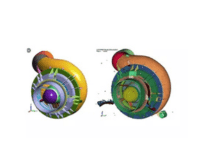
Implicit and Explicit Solvers
Easily switch between Implicit and Explicit solvers for your different runs.Implicit and explicit solvers are numerical methods used to solve differential equations, commonly applied in computational simulations such as structural analysis.
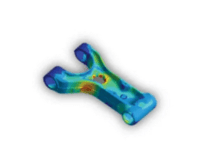
Frequency Domain Analysis
Frequency domain analysis allows LS-Dyna users to explore capabilities such as frequency response function, steady state dynamics, random vibration, response spectrum analysis, acoustics BEM and FEM, and fatigue SSD and random vibration.
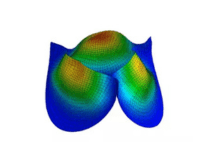
ICFD for Incompressible Fluid
ICFD solver is a stand-alone CFD code that includes a steady-state solver, transient solver, turbulence model for RANS/LES, free surface flows and isotropic/anisotropic porous media flow. Coupled to structural, EM solver and thermal solver.
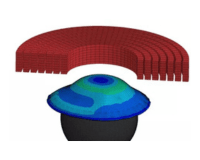
Electro magnetics Solver
EM solves the Maxwell equations using FEM & BEM in the Eddy current approximation. This is suitable for cases where the propagation of electromagnetic waves in air (or vacuum) can be considered as instantaneous. The main applications are magnetic metal forming or welding
Multiphysics Solver
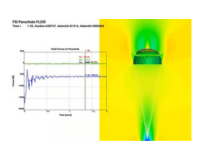
Multiphysics Solver include ICFD for Incompressible Fluids, electromagnetic solver, EM for battery abuse, and CESE for compressible fluids. Multiphysics solvers integrate various physical phenomena to simulate complex real-world applications. The ICFD
Particle Methods
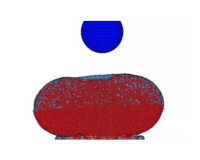
There are several particle methods using LS-Dyna. AIRBAG_PARTICLE is used for for airbag gas particles which models the gas as a set of rigid particles in random motion. PARTICLE_BLAST for high explosive particles which models high explosive gas and air modeled Particle gas.
Contact – Linear and Nonlinear
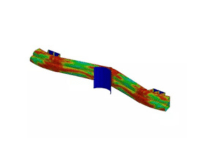
In LS-DYNA, a contact is defined by identifying (via parts, part sets, segment sets, and/or node sets) what locations are to be checked for potential penetration of a slave node through a master segment. A search for penetrations, using any of a number of different algorithms, is made every time. In the case of a penalty-based contact, when a penetration is found, a force proportional
Adaptive Remeshing
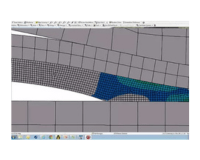
Several tools are provided for local refinement of the volume mesh in order to better capture mesh sensitive phenomenon’s such as turbulent eddies or boundary layer separation reattachment. During the geometry set up, the user can define surfaces that will be used by the mesher to specify a local mesh size inside the volume. If no internal mesh is used to specify the size, the mesher will use
Meshless SPH
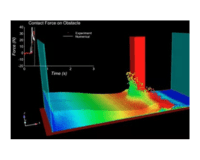
SPH method in Ansys LS-DYNA® is coupled with the finite and discrete element methods, extending its range of applications to a variety of complex problems involving multiphysics interactions of explosion or fluid-structure interaction. One of the key strengths of SPH is its ability to handle problems with large deformations and complex material failure mechanisms.
Meshless ALE
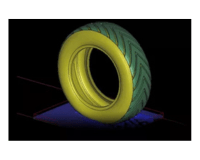
Ansys LS-DYNA has two different classes of mesh-free particle solvers: continuum-based smooth particle hydrodynamics (SPH), and discrete particle solvers using the discrete element method (DEM), the particle blast method (PBM) and the corpuscular particle method (CPM). These solvers are used in various applications like hypervelocity impacts.
Advanced CAE
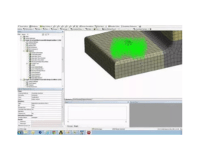
The smoothed particle Galerkin (SPG) method is a new Lagrangian particle method for simulating the severe plastic deformation and material rupture taken place in ductile material failure. The Peridynamics method is another compelling method for brittle fracture analysis in isotropic materials as well as certain composites such as CFRP. These two numerical methods share a common.
Supporting Tools
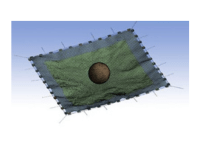
Ansys LS-OPT is a standalone design optimization and probabilistic analysis package with an interface to Ansys LS-DYNA. It is difficult to achieve an optimal design because design objectives are often in conflict. LS-OPT uses a systematic approach involving an inverse process for design optimization: First you specify the criteria and then you compute.
MODULES
Simulate the Response of Materials to Short Periods of Severe Loading
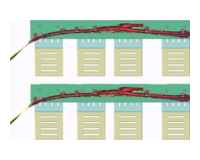
Ansys LS-DYNA is the most used explicit simulation program in the world and is capable of simulating the response of materials to short periods of severe loading. Its many elements, contact formulations, material models and other controls can be used to simulate complex models with control over all the details of the problem. Ansys LS-DYNA applications include:
Key Features
LS-DYNA elements, contact formulations, material models and other controls can be used to simulate complex models with control over all the details of the problem.
Implicit and Explicit Solvers
Frequency Domain Analysis
ICFD for Incompressible Fluid
Electromagnetics Solver
Multiphysics Solver
Particle Methods
Contact – Linear and Nonlinear
Adaptive Remeshing
Meshless – SPH and ALE
Advanced CAE
Supporting Tools
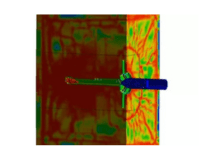
Vast array of capabilities to simulate extreme deformation problems
Engineers can tackle simulations involving material failure and look at how the failure progresses through a part or through a system. Models with large amounts of parts or surfaces interacting with each other are also easily handled, and the interactions and load passing between complex behaviors are modeled accurately. Using computers with higher numbers of CPU cores can drastically reduce solution times.
Quick Specs
Impact Analysis
Forming Solutions
Euler, Lagrange
Structural Analysis
Crash Simulation
Electro magnetics
Smoothed-Particle
Non-linear Explicit
Failure Analysis
Fluid-structure interaction
Fluid Dynamics
Model for Safety
What’s New
Introduction of Continuum Particle Gas (CPG)
Our novel particle method solver accurately solves the Navier-Stokes equations, offering a tailored approach to simulate gas dynamics in airbag deployment. The solver ensures precise modeling of gas flows, particularly around fabric internal structures, vents, and across different chambers.
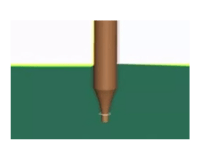
Enhanced Incompressible Smoothed Particle Galerkin (ISPG) Method
We have enhanced the ISPG (Incompressible Smoothed Particle Galerkin) method to model adhesives effectively. This versatile solver now supports various adhesive-related manufacturing processes, including glue dispensing, droplet dispersion, edge and gap filling, glue spreading, thinning, and bonding simulations.
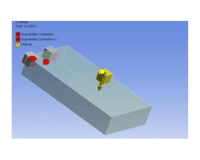
Extended Multiphysics/Battery
We have introduced new boundary conditions, isopotentials, and short definitions to enable single-cell-level simulations. By exposing ECM/HPPC data and visualizing circuit types, we have implemented significant enhancements to improve simulation accuracy and usability.