
PRODUCT OVERVIEW
Multipurpose, full wave 3D electromagnetic (EM) simulation software for designing and simulating high-frequency electronic products such as antennas, components, interconnects, connectors, ICs and PCBs.
Product Features

Physics Defines the Mesh
The Ansys HFSS simulation suite consists of a comprehensive set of solvers to address diverse electromagnetic problems ranging in detail and scale from passive IC components to extremely large-scale EM analyses such as automotive radar scenes for ADAS systems. Its reliable automatic adaptive mesh refinement lets you focus on the design instead of spending time determining and creating the best mesh.This automation and guaranteed accuracy differentiates HFSS from all other EM simulators, which require manual user control and multiple solutions to ensure that the generated mesh is suitable and accurate.

EMI/EMC Analysis
Users can take advantage of the seamless workflow in Electronics Desktop, which includes advanced electromagnetic field solvers, and dynamically link them to power circuit simulators to predict EMI/EMC performance of electrical devices. These integrated workflows avoid repetitive design iterations and costly recurrent EMC certification tests. Multiple EM solvers intended to address diverse electromagnetic problems, as well as the circuit simulators in Electronics Desktop, help engineers assess the overall performance of their electrical devices and create interference-free designs.

Radio Frequency Interference (RFI)
EMIT’s powerful analysis engine computes all important RF interactions including non-linear system component effects. Diagnosing RFI in complex environments is notoriously difficult and expensive to perform in a testing environment, but with EMIT’s dynamic linked results views, the identification of the root-cause of any interference is rapidly accomplished via graphical signal trace-back and diagnostic summaries that show the exact origin and path that interfering signals take to each receiver.
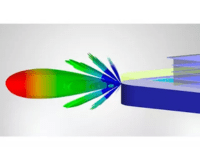
Installed Antenna and RF Cosite Analysis
A candidate array design can examine input impedances of all elements under any beam scan condition. Phased array antennas can be optimized for performance at the element, subarray or complete array level based on element match (passive or driven) far-field and near-field pattern behavior over any scan condition of interest. Infinite array modeling involves one or more antenna elements placed within a unit cell.

RF Systems and Circuits Analysis+
It includes EMIT, a unique multi-fidelity approach for predicting RF system performance in complex RF environments with multiple sources of interference. EMIT also provides the diagnostic tools needed to quickly identify root-cause RFI issues and mitigate problems early in the design cycle.

Signal and Power Integrity Analysis+
HFSS with SI Circuits can handle the complexity of modern interconnect design from die-to-die across ICs, packages, connectors and PCBs. By leveraging the HFSS advanced electromagnetic field simulation capability dynamically linked to powerful circuit and system simulation, engineers can understand the performance of high-speed electronic products long before building a prototype in hardware.
Encrypted 3D Components
The ability to simulate encrypted HFSS 3D components means that you no longer need to compromise on accuracy. Designers are no longer forced to use circuit-level components (e.g., S-parameter models) vs. true 3D models into their design, impacting the overall simulation accuracy. It enables prospective customers of vendors to use encrypted 3D Components in a full system design.
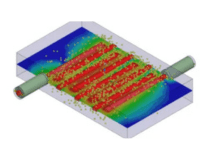
Multipaction
HFSS multipaction solver is based on a finite-element particle-in-cell (PIC) method. HFSS provides the multipaction analysis as a postprocessing of the frequency-domain field solutions. With few steps to set up the excitations and boundary conditions for charged particle simulation, you can check whether your design meets the standard for multipaction breakdown prevention.
MODULES
3D Electromagnetic Field Simulator for RF and Wireless Design
Ansys HFSS is a 3D electromagnetic (EM) simulation software for designing and simulating high-frequency electronic products such as antennas, antenna arrays, RF or microwave components, high-speed interconnects, filters, connectors, IC packages and printed circuit boards. Engineers worldwide use Ansys HFSS software to design high-frequency, high-speed electronics found in communications systems, advanced driver assistance systems (ADAS), satellites, and internet-of-things (IoT) products.
Key Features
HFSS is the premier EM tool for R&D and virtual design prototyping. It reduces design cycle time and boosts your product’s reliability and performance.
EMI/EMC analysis
Radio Frequency Interference (RFI) in complex environments
Installed antenna and RF cosite analysis
RF systems and circuits analysis
Signal and Power Integrity analysis
Quick Specs
Antenna Design Toolkit
Radar Pre/Post Processing
Frequency and Time Domain FEM
Hybrid FEM/IE/SBR+ Solver
NEW: ISO-26262 Compliant
3D Layout ECAD Flow
*SBR+ Accelerated Doppler Processing
Integral Equation (MoM)
Memory Matrix Solvers
5G Post-Processing
What’s New

Enhanced Mesh Fusion
Enhanced Mesh Fusion with improved component priority and intersection handling enables precise 3D modeling by resolving complex intersections. This ensures superior mesh quality and accurate simulations for high-tech industries, supporting SI/PI engineers and RF designers.

3D Component Array Enhancements
3D component array enhancements enable efficient simulation of multiple arrays, SBR+ regions, and lattice contacts. This capability simplifies the modeling of large-scale antenna arrays for satellite communication and aerospace, empowering antenna designers and RF engineers.
Applications

Antenna Design and Placement
Electromagnetic simulation of antenna design and its interaction with the entire system enables you to evaluate antenna placement, EMI/co-site interference and more.
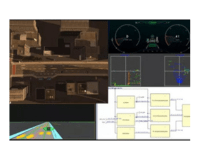
Autonomous System Validation
Ansys model-based simulation solutions enable autonomous vehicle testing and validation for software-in-loop, hardware-in-loop and driver-in-loop analysis.
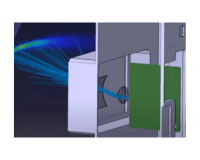
Autonomous Sensor Development
Ansys provides a comprehensive autonomous vehicle sensor simulation capability that includes lidar, radar and camera design and development.
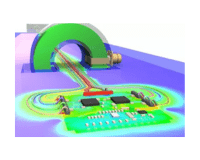
(EMI/EMC)
Minimizing electromagnetic interference with simulation delivers high-performance, compliant and safe electronics systems, down to the microchip level.
PCBs, ICs & IC packages
Ansys’ complete PCB design solution enables you to simulates PCBs, ICs, and packages and accurately evaluate an entire system.
Case Study
FAQ
What is Ansys HFSS?
Ansys HFSS is a 3D electromagnetic simulation software solution for designing and simulating high-frequency electronic products such as antennas, RF and microwave components, high-speed interconnects, filters, connectors, IC components and packages and printed circuit boards.
How do I install HFSS?
To install Ansys HFSS, you must be an Ansys customer and have access to the Customer Portal. Ansys HFSS is included in the Electronics software bundle and is also included in the free Ansys Student bundle.
Can you import STL models into Ansys HFSS?
Yes, STL is an import option in HFSS. For finite element model (FEM) analysis, STL files are converted to the HFSS modeler format. For IE and SBR+ analysis, there is an option to import and directly solve to the STL facets.
How do I download HFSS?
To download Ansys HFSS, you must be an Ansys customer and have access to the Customer Portal. Ansys HFSS is included in the Electronics software bundle and is also included in the free Ansys Student bundle.
How do I learn HFSS?
You can learn about Ansys HFSS in several different ways depending on whether you are an existing customer or a student or non-customer. Intro to Ansys HFSS is a free course available on our Ansys Innovation Courses site where you will learn the basics of Ansys HFSS geometry design and the EM simulation workflow. These HFSS courses are available to Ansys Customers.
How do I design antennas in HFSS?
Get step-by-step instructions on designing antennas in Ansys HFSS in this video, which demonstrates how to create the geometry of the dipole antenna and discusses features in HFSS for antenna analysis. “How to Design Antennas in Ansys HFSS.