
30.6%
Improvement cooling load
29.6%
Improvement daily energy
BACKGROUND
Chiller storage containers are used to transport temperature-sensitive products such as dairy, meat, fruits, vegetables and pharmaceuticals.
CHALLENGE
- Hot spots and cold spots inside the compartment, leading to product deterioration
- Cooling efficiency affected due to heat transfer through walls, roof, floor, doors and infiltration
- Frequent door openings during loading/unloading leading to temperature rise
- High ambient temperature and solar radiation, increasing the cooling load
- Inefficient insulation and cooling system resulting in higher energy usage
- Need to maintain required temperature range as per regulatory standards
APPROACH
- Developed detailed 3D model of the chiller storage container including insulation, doors, vents, evaporator and products
- Defined thermal properties of wall panels, insulation (PUF), floor, ceiling and internal loads.
- Set boundary conditions for ambient temperature, solar load and infiltration.
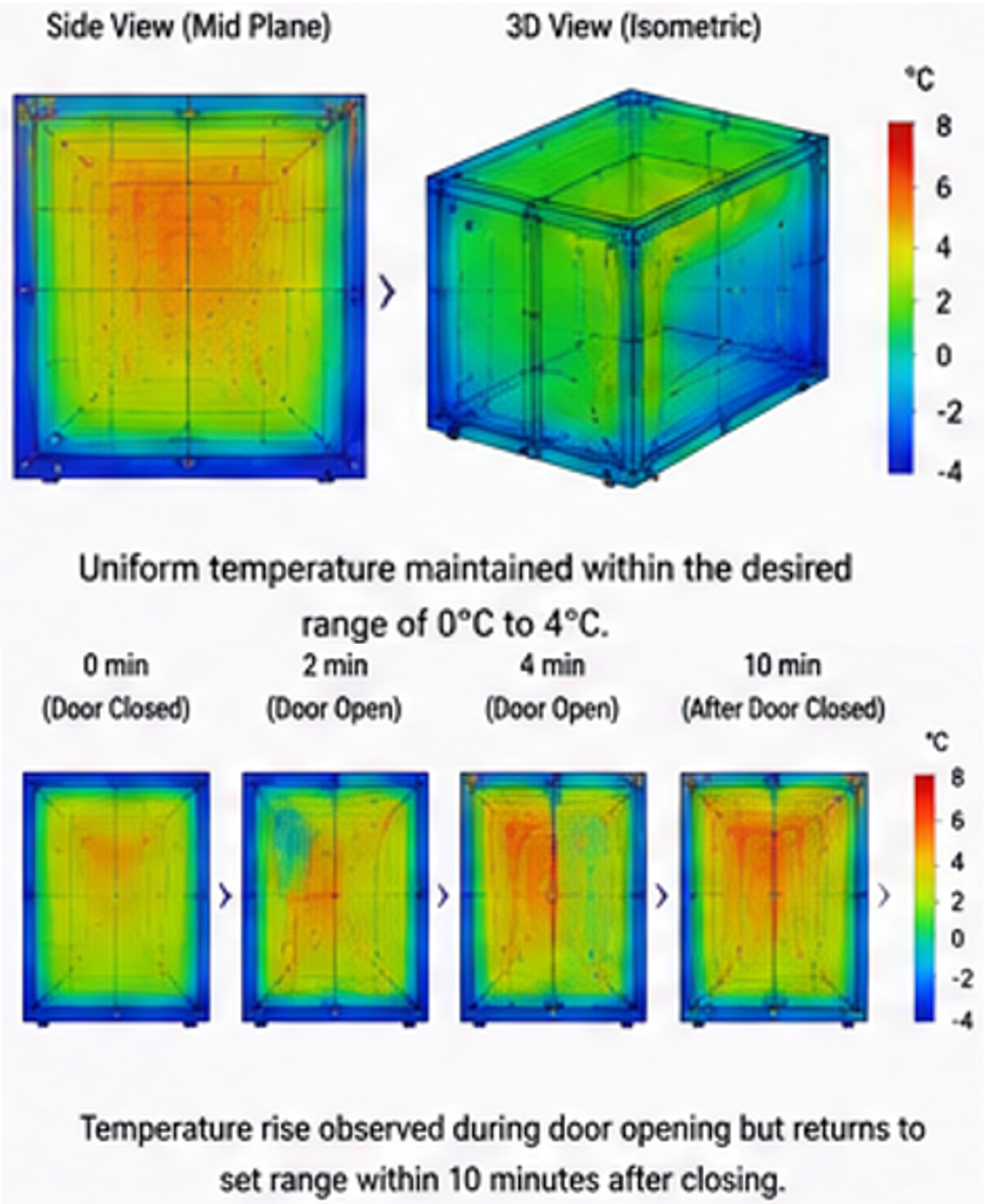
- Performed transient CFD analysis to study airflow, heat transfer and temperature distribution inside the compartment.
- CFD simulation scenarios analyzed
- • Steady state (constant ambient)
- • Door opening (frequent cycles)
- • High ambient conditions Different loading conditions
- Optimized insulation thickness, door seal, airflow distribution and evaporator placement to achieve uniform cooling and lower energy consumption.
- Simulation results validated with actual test data to ensure accuracy and reliability.